
Calculators in classrooms promote conceptual understanding by facilitating exploration of abstract concepts and providing immediate feedback for enhanced problem-solving. However, they may undermine arithmetic fluency and independent computation, potentially weakening number sense and adaptability. Teacher attitudes often dictate effective integration, influencing student performance on assessments. Further examination of strategies reveals methods to balance these dynamics for ideal learning outcomes.
Key Takeaways
- Calculators enhance exploration of abstract concepts and promote independent mathematical investigations.
- They provide immediate feedback, fostering cognitive engagement and visual learning through graphing.
- Over-reliance on calculators hinders arithmetic fluency and weakens manual calculation skills.
- Calculator use can limit pattern recognition and reduce overall number sense in students.
- Strategic integration improves performance on technology-enhanced assessments but requires balanced implementation.
Benefits of Calculators for Conceptual Learning
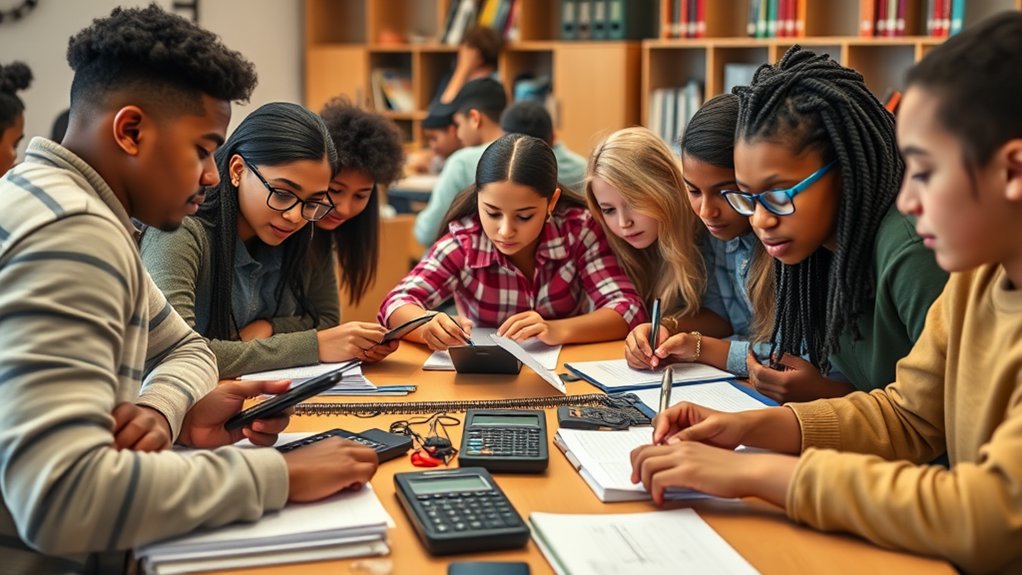
Calculators provide significant benefits for conceptual learning in mathematics by enabling students to explore abstract concepts through interactive and efficient tools. Conceptual exploration is fostered through activities that encourage students to investigate mathematical relationships independently, with immediate feedback reducing anxiety and promoting trial-and-error cycles. Visual learning plays a key role, as graphical capabilities allow plotting functions and connecting concrete data inputs to abstract ideas, such as proportionality and benchmark estimation. This approach enhances number sense by facilitating comparisons of numerical representations and reasoning about significant figures. Calculators accelerate learning progress, enabling quicker mastery of complex concepts like algebraic modeling and statistical datasets, while supporting iterative problem-solving. By empowering students to validate theories experimentally, these tools build confidence and facilitate higher-level strategies, ultimately deepening mathematical understanding without computational burdens. Furthermore, research indicates that graphing calculators contribute to deeper conceptual understanding by enhancing students’ grasp of functions and variables in applied contexts. Additionally, calculators promote productive struggle by allowing students to engage in independent discovery of mathematical strategies through guided exploration.
Drawbacks in Developing Core Computational Skills
While calculators offer advantages in conceptual exploration, their routine use presents notable drawbacks in fostering core computational skills, particularly through over-reliance that hinders arithmetic fluency and manual calculation proficiency. Computational skill atrophy manifests as over-reliance strips away repetition and reinforcement essential for mastering basic arithmetic and math facts, leading to declines in arithmetic fluency and muscle memory for multi-digit problems. This dependence also weakens adaptability in problem-solving and reduces precision in non-routine calculations requiring manual verification. Concurrently, cognitive engagement decline occurs, with limited reflection on errors and shorter problem-solving durations that promote surface-level understanding over deep conceptual processing. Such effects diminish pattern recognition and overall number sense, ultimately hindering students’ ability to develop robust computational proficiency through unmediated practice.
Teacher Attitudes and Their Impact on Usage
Teacher beliefs frequently override curriculum guidelines in shaping the integration of calculators in educational settings. Attitudes toward technology directly influence the frequency and sophistication of calculator usage, as evidenced by studies linking educator mindsets to classroom practices. This precedence of personal convictions underscores the critical role of addressing teacher perspectives in optimizing technology adoption. Notably, research shows that 84% of award-winning teachers endorse regular calculator use to enhance student learning outcomes.
Beliefs Override Curriculum
Educator beliefs frequently overshadow institutional curricula in calculator integration, shaping classroom practices despite official endorsements. Teacher biases, rooted in historical resistance to calculators for preserving computational competence, create curricular inconsistencies where prescribed standards clash with individual attitudes. For instance, while 85% of primary teachers endorse calculators, only 32% implement them in K-6 classrooms, driven more by personal reservations than policy directives. This discrepancy arises from conflicting guidance, as educators and parents favor conservative approaches over recommendations from organizations like the NCTM. Consequently, resource gaps and policy ambiguities exacerbate these inconsistencies, prioritizing belief-driven instruction over evidence-based curricular integration, ultimately hindering uniform adoption across educational settings.
Attitudes Shape Usage
The impact of teacher attitudes on calculator usage in classrooms often determines the extent of technological integration, overriding formal curricula. Teacher beliefs greatly influence classroom dynamics, with supportive educators fostering environments where calculators enhance conceptual understanding and problem-solving skills. For instance, professional development has yielded a 20% improvement in attitudes, linking positive beliefs to better student outcomes, as evidenced by research. Conversely, barriers such as initial resistance from skill erosion concerns and insufficient resources limit adoption, particularly among older educators favoring traditional methods. Over 600 studies affirm that teacher autonomy in aligning tools with lesson goals shifts focus from rote calculations to mathematical reasoning, though community reservations and policy ambiguities further complicate dynamics, ultimately dictating implementation frequency.
Effects on Student Performance in Assessments

Calculators demonstrate both positive and negative effects on student performance in assessments, depending on task complexity and implementation. Calculator efficacy positively correlates with assessment outcomes in technology-enhanced items, enhancing problem-solving skills and accuracy in graphing and data analysis tasks. For instance, graphing calculators improve math achievement in advanced assessments like TIMSS, allowing students to focus on conceptual understanding rather than routine calculations. In college settings, calculator groups outperform non-calculator counterparts, attributed to targeted learning experiences. Weekly calculator use for data analysis has been shown to lead to higher math scores based on statistical evidence.
Conversely, calculator efficacy shows no significant impact on standardized tests, such as TIMSS 2015 Advanced scores (p=0.265), particularly for basic arithmetic. Demographic factors like socioeconomic status fail to predict outcomes in calculator conditions, and overreliance hinders mental math fluency. Task-specific impacts reveal advantages in multi-step problems, where calculators reduce errors and support higher-order cognition, but minimal benefits in trivial tasks underscore variable effectiveness. Hierarchical modeling confirms mixed results, emphasizing dependency on implementation.
Strategies for Integrating Calculators Into Lessons
Effective integration strategies emphasize encouraging critical thinking, such as requiring students to estimate answers mentally before verification, and designing open-ended problems to shift focus from computation to conceptual exploration. To achieve calculator consistency, educators implement integrated math instruction, combining subjects like algebra and geometry to foster teaching balance between manual reasoning and tool-assisted analysis. Strategies include discriminating tool selection, where problems promote situational awareness for when calculators enhance efficiency, and conceptual investigations using devices for pattern exploration in functions. Guided inquiry involves real-world modeling for immediate feedback and error analysis workshops to reinforce arithmetic integrity. Differentiated instruction offers tiered tasks, ensuring accessibility via visual aids and cooperative learning, while aligning with curriculum through assessments that prioritize strategic use over rote skills. Additionally, programs have successfully integrated specific calculators, such as the TI-73 model, to enhance learning in mathematics courses. This approach maintains teaching balance, integrating calculators without undermining foundational competencies.
Enhancements in Problem-Solving and Engagement
While manual computations often constrain cognitive resources, integrating calculators into classroom activities bolsters problem-solving capabilities and student engagement by enhancing reasoning skills, increasing success rates in tasks like equation analysis, and fostering interactive exploration that sustains motivation and reduces error risks. Solution visualization allows students to dynamically adapt strategies, fostering cognitive engagement by shifting focus from rote arithmetic to abstract reasoning and pattern recognition. This approach yields higher mean scores in equation tasks, as evidenced by studies showing improved computational fluency and error reduction in complex scenarios. Additionally, calculators promote cognitive engagement through real-time feedback, enabling better progress monitoring and collaborative exploration, which boosts positive attitudes and sustains motivation among average-ability students without undermining foundational skills. Overall, these enhancements align with structured learning models, facilitating deeper conceptual understanding and iterative problem-solving refinement.
Trends in Calculator Accessibility Across Grades
Accessibility trends in calculator use across educational grades reflect evolving adoption patterns, particularly in middle and high schools, where devices serve as tools for equitable learning and align with state standards emphasizing conceptual mathematics. Grade adoption intensifies in grades 6–12, driven by research highlighting calculators as practical tools for conceptual understanding and STEM preparation, with middle schools prioritizing alignment to state curricula and high schools integrating graphing models for advanced applications. Calculator equity emerges as a key factor, with public schools leveraging funding grants and federal mandates to guarantee device accessibility, mitigating socioeconomic barriers and supporting students with disabilities. Earlier grades exhibit restrained adoption due to concerns over foundational arithmetic proficiency, though trends indicate gradual expansion as technology costs decline. Overall, these patterns foster equitable opportunities, enabling students to demonstrate mathematical knowledge without procedural hindrances, though implementation requires targeted training for peak efficacy.
Frequently Asked Questions
Do Calculators Help Students With Disabilities?
Calculators, as assistive technology, help students with disabilities by enhancing learning strategies through improved computational accuracy, efficiency, and reduced anxiety, thereby boosting assessment success and access to advanced concepts. However, they risk fostering over-reliance, potentially undermining basic skill development, and exhibit variable effectiveness across disability types, necessitating personalized implementation to balance benefits and drawbacks.
What Is the Cost of School Calculators?
The cost of school calculators varies by type and brand, with basic models from Casio starting at $5–$20, scientific calculators at $50–$150, and graphing options like TI-84 reaching $100–$300. Budget considerations include initial purchases, ongoing expenses such as batteries and replacements, and strategies like bulk institutional buys or digital alternatives to minimize costs. Long-term planning accounts for maintenance, obsolescence, and cost-effectiveness in educational settings.
Can Calculators Aid Remote Learning?
Calculators aid remote learning by facilitating virtual practice, where students engage in independent problem-solving tasks without physical constraints. They provide effective feedback through real-time verification, enabling self-paced error correction and reduced cognitive load. This promotes higher-order thinking, aligns with digital platforms, and enhances mathematics proficiency, as evidenced by increased correct responses in technology-enhanced environments. Overall, they support equitable and motivated remote education.
How Do Calculators Affect Group Work?
Calculators affect group work by enhancing calculator collaboration and influencing group dynamics. Students engage in supportive discussions, with no observed instances of ignoring responses and rare interruptions, fostering respectful interactions and reducing exclusions. This promotes inclusive participation and shifts focus to analytical reasoning, enabling deeper problem-solving on complex tasks. However, structured guidelines are essential to mitigate potential disruptions and guarantee accountability in diverse learning settings.
Which Calculator Types Suit Different Grades?
Basic calculators suit elementary grades (K-5) for mastering arithmetic operations like fractions and decimals, minimizing cognitive complexity. Scientific calculators are appropriate for middle school (6-8), enabling trigonometric functions and basic graphing for algebra and statistics. High school (9-12) demands advanced scientific calculators for logarithms, calculus, and complex visualizations, while college levels require enhanced models with programming and matrix operations for rigorous STEM applications.
Conclusion
To summarize, the use of calculators in classrooms offers benefits such as enhanced conceptual learning and problem-solving capabilities, alongside drawbacks including weakened core computational skills. Teacher attitudes and strategic integration greatly influence student performance and engagement, while increasing accessibility across grade levels necessitates balanced educational approaches to optimize outcomes without compromising foundational abilities.
References
- https://files.eric.ed.gov/fulltext/ED525547.pdf
- https://indigo.uic.edu/articles/thesis/The_Effects_of_Teacher_Calculator_Use_in_Mathematics_Classrooms_and_Assessment/23661702
- https://www.nctm.org/News-and-Calendar/Messages-from-the-President/Archive/Lee-V_-Stiff/Making-Calculator-Use-Add-Up/
- https://digitalcommons.unl.edu/cgi/viewcontent.cgi?article=1060&context=mathmidactionresearch
- https://nces.ed.gov/pubs92/web/92060.asp
- https://www.edutopia.org/article/using-calculators-deepen-students-engagement-math/
- https://files.eric.ed.gov/fulltext/EJ1075175.pdf
- https://www.teachingbyscience.com/calculator
- https://education.ti.com/en/resources/funding-and-research/research/research_teachingandlearning
- https://digitalcommons.odu.edu/cgi/viewcontent.cgi?article=1088&context=ots_masters_projects